Tuesday, October 20, 2009

Do you believe in miracles?

Do you believe in miracles?

Another way to phrase the question is: "Do you consider yourself lucky?" That was the question Parul posted in a LPG meeting a couple of years ago. Several of us answered: "Yes."

And I remember saying: "I expect to be lucky."

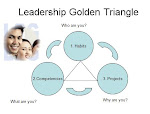
I didn't know it at the time. I was in fact mouthing off the Golden Leadership Triangle: the foundational LPG principles of iteratively working on Habits, Competencies and Projects.

The most basic habit is: Be Proactive. One way to be proactive is to "Begin with an End" and look for positive signs of progress--not longing for these signs, but continuously develop competencies and do projects that would lead to progress. But don't be picky about what those positive signs have to look like because God (the universe) works in mysterious way.

Here is an example.

Last year just before my retirement from IBM, at a special Toastmaster meeting organized by Rich and run by Mike on leadership and collaboration, Mike posted this question to the team, "What is your life purpose? And how do you know if you are making progress?"

When it came to my turn to respond, I said: "I will know when I am making progress toward contributing to building a "flat world" when I find and work on some human potential development projects".

Somewhat in jest, I added: "And you will know that I am making progress if you see me on the Post Bulletin."

A year later, I open up the Post Bulletin last night and found that there is something there that talks about, no, not me directly, but the work I helped do.

You see I have been helping Diversity Council build a web-based fund-raising event, which we call Non Event.

I knew that we were going to roll it out in November but had no idea that PB was going to have front-page article on it.

As I do LPG, the lessons I learn repeatedly are: Begin with the End in Mind, step by step (First Things First), develop the skills, do the work and deliberately, proactively and optimistically look for signs of progress. These positive signs do not have be exactly what you thought they would be like but you will know them when you look for them.

Next LPG meeting, we will recap and discuss the power of Golden Leadership Triangle.

What about you? Do you believe in miracles?

Thursday, September 24, 2009

Dealing with Difficult People

How to deal with difficult people? Don't we wish we had the magic formula to do just that.

How many times have we said to ourselves, "We can do so much better, if only we didn't have to deal with so and so?"

Last LPG we listened to several folk stories about difficult people and we discussed what wisdom we each drew from these stories.

For myself, the wisdom came from the introspective questions raised during our discussions:
"In relationships, am I the difficult person?"
"Am I sometimes being too insistent?"
"Am I not the stubborn one?"
"Am I really being pro-active? Do I seek first to understand?"

Since the LPG meeting, I relearned the lesson of: "Be the change you want to see in the world."

Be a bit more patient, be a bit more open-minded, be a bit more optimistic, have a bit more faith that things will work out.

With that mental adjustment, things have turned out pretty well.

And it has been quite a couple of weeks with a number of delightful "wins"--the latest is an opportunity to work with RCTC to host a China-US Town Hall meeting in December that has potential national visibility.

Tomorrow's LPG meeting, we will continue with How To Deal with Difficult People. Given the results from our last meeting, I can only say ... "Bring it on."

Thursday, September 10, 2009

How to deal with difficult poeple

Last LPG we talked about forgiveness, we focused on the idea that forgiving does not mean not holding the perpetrator or our tormentor accountable for their actions but to let go of the anger, the hurt and the continual cycle of revenge toward them.

Great leaders all have that ability. Two years after surviving near-fatal gunshot wounds, Pope John Paul II visited his would-be assassin, Mehmet Ali Ağca,

According to Wikipedia,

'the two spoke privately for 20 minutes.[5] John Paul II said, “What we talked about will have to remain a secret between him and me. I spoke to him as a brother whom I have pardoned and who has my complete trust.″

'

It would be up to our imagination what they did talk about. It does strike me that forgiving is more thoughts and actions then words. True forgiveness is purity and does not convey arrogance, pompousness or ego gratification. It's often private. But when it does occur, the world becomes a bit lighter.

Tomorrow's LPG we are going to work on something a bit more practical. We will discuss how to deal with difficult people. To me cultivating FACT (forgiveness, acceptance, compassion, and true purposes) in myself is probably a good starting point.

Thursday, August 27, 2009

Forgiveness Option

Last LPG we touched upon FACT (Forgiveness, Acceptance, Compassion, True Meaning and Purpose) as ways to attaining Principle-based interpretations.

And we made a pact as a group after the meeting to consciously perform some acts of forgiveness and acceptance. On reflection, I have not always taken advantage of all the opportunities that life had offered me the last two weeks to readily forgive and accept.

In particular, I have fallen short too often of the teachings from Harry Palmer's Forgiveness Option mini-course. He said,

"One realization that you may want to carry with you is that since you have the choice of whether or not to forgive, you also have the choice of whether or not to take offense. Not choosing to be offended is proactive forgiveness."

On too many occasions, I had been critical of people's actions, fallen victim to by my mind's conception of being slighted, overlooked, taken for granted or insulted.

But I also know I need to accept my imperfection and learn to forgive myself.

What about you? What have you learned? What do you think you will learn as we get back together tomorrow to recount our own experience of trying to accept and to forgive.

Ashok's slides on Breathing is available on this LPG page.

Tuesday, August 18, 2009

Where does attention come from?

Do you control your mind? Or, does your mind control you? What is brain and what is mind?
Where does attention come from? Where does interpretation come from? What are 3Ps (prejudices, preferences, principles)? What are principle-based interpretations?

These were some of the questions we talked about last LPG.

We also did an Avatar exercise called "This and That" to let us experience what it's like to direct our attention.

After the exercise, we contemplated on "who/what" were doing the attention directing--Mind or Brain?

Or, could it be as Covey's Habit 1 says "Be Proactive ... We all have a free will". But then what is will? And where does will come from?

Chinese have a saying: "The finger pointing to the moon is not the moon." And I had an impression in our last LPG meeting there were one or two moments, we got pass the finger and felt the moon.

Next LPG meeting's agenda is still open. Let me know if anyone has a preference.

Team Transformation

Ashok sent me this site about "Inventing, designing, developing, and delivering tools, processes and environments that facilitate individuals and organizations in their transition to a knowledge-based, design-focused world."

Wednesday, August 12, 2009

Attention + Interpretation = Action

I was told and I believe the Dalai Lama, Mother Teresa and Pope John Paul all have one thing in common. They are present. Even in the midst of a large throng of admirers who want to touch them and talk to them, when they stop to talk to one individual, they have the ability to be present with that individual as if that person is the only person in the world. In other word, they have uncanny ability to pay attention and be focused.

By contrast, we all know people who are always fidgetty. They can't sit still. When they talk to you, they are easily distracted--they will look at the Black Berries, or constantly glancing around at every movement that lurks in their sight of vision. They may be physically next to you, you know they don't hear what your are saying to them. They are not present.

Last LPG meeting we did a number of exercises to let us experience what it feels like to direct one's attention., to train your mind to let go of thoughts, and to suspend judgment as you observe objects.

Next LPG meeting
, we will continue with Dr. Sood's presentation. I am going to engage you to talk about things like:
1. Where does attention come from?
2. What does Sood mean by Attention + Interpretation = Action.
3. What is TPN?
4. Where do Interpretations come come?
5. What is FACT? And how does it neutralize emtional charges?

As always., LPG is about exploration and getting you to open up and talk about these things. There are no right or wrong answers. There is only participation.

See you there.